










As of the most recent Curriculum SCOPE Survey, 77% of U.S. and Canadian MD/DO-granting medical schools report covering AI somewhere in their curriculum, up from roughly 24% less than a year earlier.
That's genuine, fast progress. But coverage is not the same as competency: even as access has expanded, most faculty and students who've been surveyed still self-identify as novice AI users. The crisis hasn't disappeared. It has moved from a curriculum-access gap to an AI-proficiency gap, and that's arguably a harder problem to solve.
How big was the original gap?
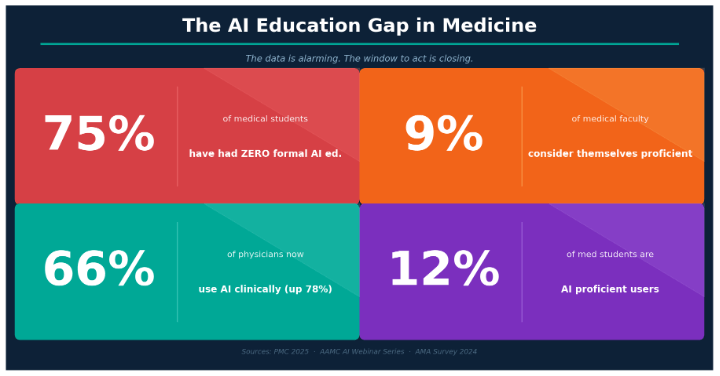
Not long ago, most medical students received almost no formal training in the use of AI. Multiple surveys found that a large majority of students had never had a single dedicated hour of AI instruction, even as they were already using generative AI tools daily to study, draft notes, and research differentials. Nobody was teaching them how to do that well, or when not to trust the output at all. Having spent my career building medical education at scale, from clinical teaching floors to platforms reaching hundreds of thousands of learners, I had not seen a gap that dangerous between what learners were already doing and what anyone was actively teaching them.
What changed?
In the span of about a year, AI curriculum coverage more than tripled. A 2026 cross-sectional study in JMIR Human Factors found adoption climbing from roughly 24% in May 2024 to 77% by February 2025, alongside data showing more than 90% of medical students now regularly use two or more AI platforms, and over 60% use three or more. The AAMC has documented the same shift from the institutional side: a recent feature, "Medical schools move from worrying about AI to teaching it," describes a landscape transformed in just two years, a period in which, as one Stanford medical education leader put it, half of physicians didn't yet know what a chatbot was.
That shift is visible in specific programs now live across the country. Stanford has built a dedicated Medical AI track into its MD curriculum. Harvard Medical School now offers an AI in Medicine PhD and a course called Computationally Enabled Medicine that applies AI to genomic and epidemiological data. The University of Virginia has students practice AI-assisted diagnosis and treatment planning on simulated patients before ever touching the skill with a real one. The University of Texas Health Science Center at San Antonio now offers a dual degree combining medicine and AI for students willing to take an extra year. Mayo Clinic has gone a different direction with a "Human Skills in the Age of AI" course explicitly designed to protect empathy and communication as AI absorbs more cognitive tasks.
So is the gap solved?
No. Curriculum coverage answers the question "did students encounter AI content somewhere in their training." It doesn't answer "can students actually use AI well, critically, and safely." Even in the institutions reporting the steepest gains in coverage, faculty and student self-assessments still skew toward "novice" when asked about their own AI competency. We've successfully scaled exposure. We have not yet scaled proficiency , and those are very different curricular goals requiring very different teaching strategies.
This is the same distinction the AAMC draws in its companion piece, "Medical schools assign students a new coach: AI", schools are increasingly using AI as a teaching tool, not just a teaching topic, precisely because passive exposure to AI content wasn't moving the needle on actual skill.
Why is curriculum redesign still so hard?
Medical curricula are already overpacked. The recent clamor for additional nutrition training in UME has made that clear. Carving out space for AI literacy can feel impossible when every credit hour is already being fought over between anatomy and biochemistry. But here's the structural reality: refusing to address AI head-on isn't a neutral choice. It's a choice to produce graduates who are fluent users of a tool they were never formally taught to evaluate critically, which is precisely the setup for the "false proficiency" risk described in the never-skilling research we covered earlier in this series.
The schools getting this right are not adding a single AI course bolted onto year two and calling it done. They're threading AI literacy, critical appraisal of AI-generated output, and the ethics of AI use vertically through every year, every clerkship, and every simulation, the same way communication skills or evidence-based medicine got integrated a generation ago.
What's the honest path forward?
The encouraging part: the foundational skills AI competency actually demands, such as systems thinking, critical appraisal of evidence, and data literacy, are things medical education should have been teaching more rigorously regardless of AI. Closing the proficiency gap doesn't require an entirely new curriculum philosophy. It requires applying the curriculum philosophy we already know works to a new and urgent subject.
What about faculty? Who is teaching the teachers?
There's a piece of this that doesn't show up in the student-facing statistics: faculty development has lagged student-facing curriculum change. A program can roll out a new AI module for second-years in a semester; it takes considerably longer to get a critical mass of faculty comfortable enough with the tools to supervise their use credibly, model good judgment about when to trust an output, and grade reasoning rather than just polish. Several of the AAMC's recent initiatives, including dedicated faculty training resources on AI best practices, exist precisely because schools learned the hard way that you cannot scale trainee AI literacy faster than you scale faculty AI literacy. A curriculum is only as good as the people delivering it, and right now, in most institutions, the faculty pipeline for this is still catching up to the student-facing one.
FREQUENTLY ASKED QUESTIONS
Q: What percentage of medical schools teach AI?
A: According to the Curriculum SCOPE Survey, 77% of U.S. and Canadian MD/DO-granting medical schools reported covering AI in their curriculum, up from approximately 24% less than a year prior — one of the fastest curricular shifts in recent medical education history.
Q: Which medical schools have notable AI programs?
A: Stanford (a dedicated Medical AI track), Harvard (an AI in Medicine PhD and a Computationally Enabled Medicine course), the University of Virginia (simulated AI-assisted diagnosis practice), UT Health San Antonio (a dual medicine/AI degree), and Mayo Clinic (a "Human Skills in the Age of AI" course) are frequently cited examples of vertical AI integration.
Q: Is teaching AI in the curriculum the same as students being AI-competent?
A: No. Survey data shows that even as curriculum coverage has expanded rapidly, most surveyed faculty and students still self-identify as novice AI users — meaning exposure to AI content has outpaced measurable proficiency.
Q: What is the most effective way to teach AI literacy in medical school?
A: Emerging best practice favors vertical integration — threading AI literacy, critical appraisal, and ethics across every year and clerkship — over a single standalone AI course, mirroring how evidence-based medicine was integrated into curricula in prior decades.
SOURCES & CITATIONS
• Curriculum SCOPE Survey, 2023-2024 cycle (AAMC).
• Medical schools move from worrying about AI to teaching it. AAMC, 2026.
• Medical schools assign students a new coach: AI. AAMC, 2026.
• JMIR Human Factors, 2026;e81652 — cross-sectional study on medical student AI adoption.
• Artificial Intelligence Competencies Across the Learning Continuum. AAMC.